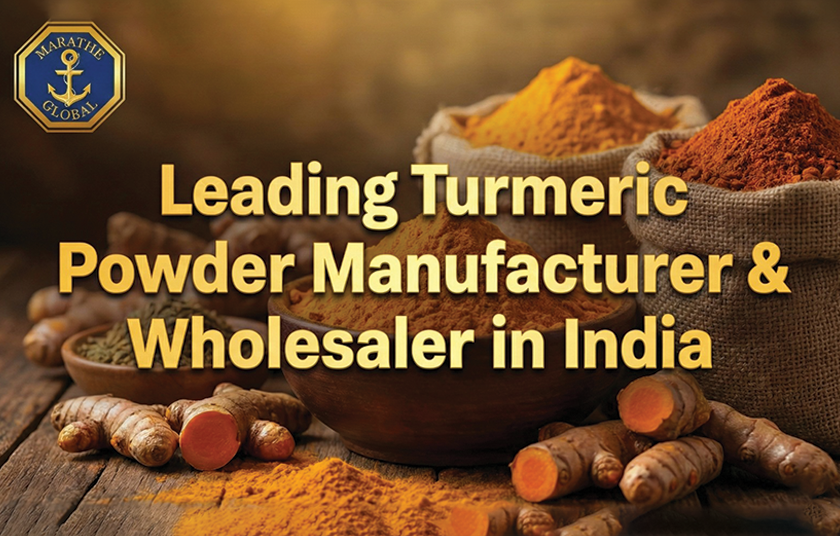
From ancient Ayurveda scrolls to modern nutrition shelves, turmeric has carried India’s scent and spirit across borders. Today, this golden spice isn’t just a kitchen essential—it’s a billion-dollar export engine powering India’s agri-economy.
The global turmeric market, valued at nearly USD 3.5 billion in 2023, is projected to grow at a CAGR of around 6.2% between 2024 and 2030. And leading this surge is India—responsible for over 80% of global turmeric exports. The rise isn’t just about volume; it’s about purity, consistency, and the credibility that Indian manufacturers have earned in international markets.
India’s dominance in turmeric exports is rooted in soil, science, and soul. The rich loamy soils of Andhra Pradesh, Maharashtra, and Tamil Nadu yield turmeric with naturally high curcumin content (2–5%), giving it unmatched color and potency.
But the country’s edge isn’t just natural—it’s structural. Indian exporters have invested in:
Modern processing units with automated grinding and sterilization lines.
Strict quality certifications like FSSAI, ISO, HACCP, and GMP.
Sustainable farming practices that ensure traceability and clean-label compliance.
Buyers across the U.S., UAE, Japan, and Europe choose Indian turmeric not only for its authentic hue and aroma, but for the reliability that certified exporters bring to the table.
The statistics tell their own story:
India’s annual turmeric production: Over 1 million metric tonnes.
Export volume (2023): Roughly 160,000 metric tonnes.
Key importers: U.S., Bangladesh, UAE, Japan, Malaysia, and the U.K.
Average export growth rate (CAGR): 5.5–6%, driven by rising health awareness and global demand for natural ingredients.
|
Metric |
Data (Approx.) |
Insight |
|
Global Turmeric Market Value (2023) |
USD 3.5 Billion |
India holds 80% share |
|
Projected Market Value (2030) |
USD 5.3 Billion |
CAGR 6.2% |
|
India’s Export Share |
80–85% |
Global leader |
|
Average Curcumin Content |
2–5% |
High-grade product quality |
A household name in India and abroad, Everest blends traditional sourcing with mass-scale production. Their turmeric powder is widely distributed, though large-scale manufacturing occasionally limits customized export solutions.
MDH has been synonymous with Indian masalas for decades. Their turmeric powder maintains consistent flavor profiles, but they largely serve domestic markets with limited bulk export options.
Known for regional spice excellence, Vasant’s turmeric is vibrant and aromatic. Their export footprint is growing, but they remain more consumer-focused than B2B export-oriented.
Based in the “Turmeric City,” Nani Agro is strong in bulk turmeric sourcing. They hold solid HACCP certifications, though supply scalability across continents is still developing.
With deep roots in the spice belt, Shalimar emphasizes organic turmeric varieties. Their production capacity, while premium in quality, is moderate compared to top-tier exporters.
Natureland’s focus on organic, chemical-free turmeric appeals to Western buyers. Their challenge lies in higher pricing due to certification costs, but they’ve built strong trust among clean-label consumers.
A prominent manufacturer with modern processing units. Rajesh Spices export across 25+ countries, maintaining consistency and hygiene standards. However, curcumin testing transparency could be improved.
Specializing in turmeric finger and powder exports, Vyasa is noted for its quality control and sustainable practices. Still, their packaging variety and brand storytelling lag behind industry leaders.
Operating from India’s turmeric hub, Sangli exporters serve a vast global clientele. Their supply strength is undeniable, though batch purity variation can be an occasional challenge.
At the top of this list stands Marathe Global, not merely as a manufacturer, but as a new-age export house built on integrity and precision. Based in Mumbai, Marathe Global has set a gold standard for turmeric powder exports, blending India’s heritage with modern trade discipline.
Their turmeric powder—tested and verified at 3% curcumin content—meets the ideal export-grade requirement for vibrant color and strong antioxidant potency. Each 25kg PP bag is packed under strict hygiene conditions, designed for long-haul consistency and freshness.
Where many exporters chase scale, Marathe Global focuses on trust and traceability. Their MOQ system (50 MT) ensures bulk consistency while maintaining uncompromising quality. The team operates with transparent payment terms, ethical procurement, and international compliance—all built to reassure global buyers.
Mini Case Insight:
A recent export to the Middle East demonstrated Marathe Global’s edge—delivering on time despite port delays, without compromising on curcumin verification or packaging quality. That level of accountability makes them not just another exporter, but a long-term trade partner for buyers seeking reliability.
What sets them apart:
Verified 3% curcumin turmeric powder
Premium-grade, contamination-free processing
Ethical sourcing with full documentation
Global presence with a high client-retention rate
On-time, every time delivery promise
Where others showcase volume, Marathe Global showcases values—making it the most dependable name among India’s turmeric exporters leading the global spice market.
The next wave of growth in turmeric trade is data-backed and driven by lifestyle shifts:
Rising demand for organic turmeric – global CAGR of 8.1% through 2030.
Health and wellness boom – curcumin-based supplements are now a $250M industry.
Tech-driven traceability – exporters adopting blockchain tracking to verify farm origins.
Competition check – emerging turmeric sources from Vietnam and Myanmar, yet India remains unshaken due to quality depth and legacy trust.
India contributes over 80% of global turmeric supply.
Erode is called the “Turmeric City of India.”
Curcumin content directly determines export pricing tiers.
The U.S., UAE, and Bangladesh are India’s top import destinations.
Organic turmeric demand has surged at over 12% CAGR since 2020.
India’s turmeric story is a mix of culture, chemistry, and commerce. As global consumers lean toward clean, natural products, Indian turmeric exporters are scripting a new era of responsible trade.
Among these, Marathe Global stands as a beacon of what modern export ethics should look like—where transparency, consistency, and tradition merge into something far more valuable than a product: trust.
When the world looks for gold, it doesn’t always shine. But when it’s Marathe Global’s turmeric powder, it truly does.
.png)
.png)